Selling crypto, swapping one coin for another or spending it are all CGT events in Australia. Your capital gain is what you got for the coins minus their cost base, and if you held them for at least 12 months as a resident individual, the gain is halved after you subtract your capital losses. That halving is being replaced for gains that build up after 1 July 2027.
| Tax year | 1 July to 30 June |
| Lodge by | 31 October (later if you use a registered tax agent) |
| What's taxed | Net capital gain, added to your other income |
| Crypto-to-crypto swaps | Taxable: a CGT event happens to the coin you gave up |
| Holding period | 12 months or more: 50% CGT discount for resident individuals |
| Cost method | Identify the parcels you sold, or first-in, first-out |
Swaps count, not just cashing out
The ATO is explicit that exchanging one crypto asset for another is a CGT event for the coin you gave up. Its value in Australian dollars at the time of the swap is your capital proceeds, and it becomes the cost base of the coin you received. People who never sold to dollars are often surprised by this: a year of trading between coins can produce a tax bill with no cash ever leaving the exchange.
The 12-month discount, and 1 July 2027
If you owned the coins for at least 12 months, the gain can be reduced by 50%. The ATO counts the 12 months without the day you acquired the asset and the day you disposed of it, so a coin bought on 1 July 2025 qualifies if you sell it on 2 July 2026 or later.
Two details decide how much the discount is worth:
- Capital losses come off first. You subtract this year's losses (and any carried forward) from your gains, and only then halve what's left of the discount-eligible part.
- It's for individuals and trusts, not companies, and generally only for Australian residents.
The ATO has confirmed that, from 1 July 2027, the 50% discount for individuals is replaced by cost base indexation plus a 30% minimum tax on capital gains, and that these measures are now law. They apply to gains that accrue after that date, so Tax Time 2026 and 2027 returns still use the discount. If you hold coins across that date, keep a record of their value on 1 July 2027.
Which parcels did you sell?
The ATO's crypto pages don't prescribe a method. Its general guidance for identical assets lets you identify the particular parcels you sold when your records support it, and otherwise work on a first-in, first-out basis. What you can't do is pick whichever parcels give the best result without records that show those were the ones sold.
The calculator below uses FIFO and shows how much of your gain came from coins held at least 12 months, which is the figure the discount applies to.
The personal use exemption rarely applies
A gain on crypto that is a personal use asset is ignored if you acquired it for less than $10,000. The ATO means crypto bought and used to pay for things for yourself within a short time. Coins you hold as an investment, or even just hold for a while hoping they rise, aren't personal use assets. Losses on personal use assets are ignored too.
Where Australians trade
Binance serves Australian residents through Binance Australia, which is registered with AUSTRAC as a digital currency exchange. Its transaction history export is the same statement our converter and calculator read. If you're opening an account, our Binance sign-up guide covers identity checks and the settings that make the yearly export easier to deal with.
Sources
- ATO, CGT discount (updated 29 June 2026)
- ATO, Tax reform: capital gains tax changes (29 June 2026)
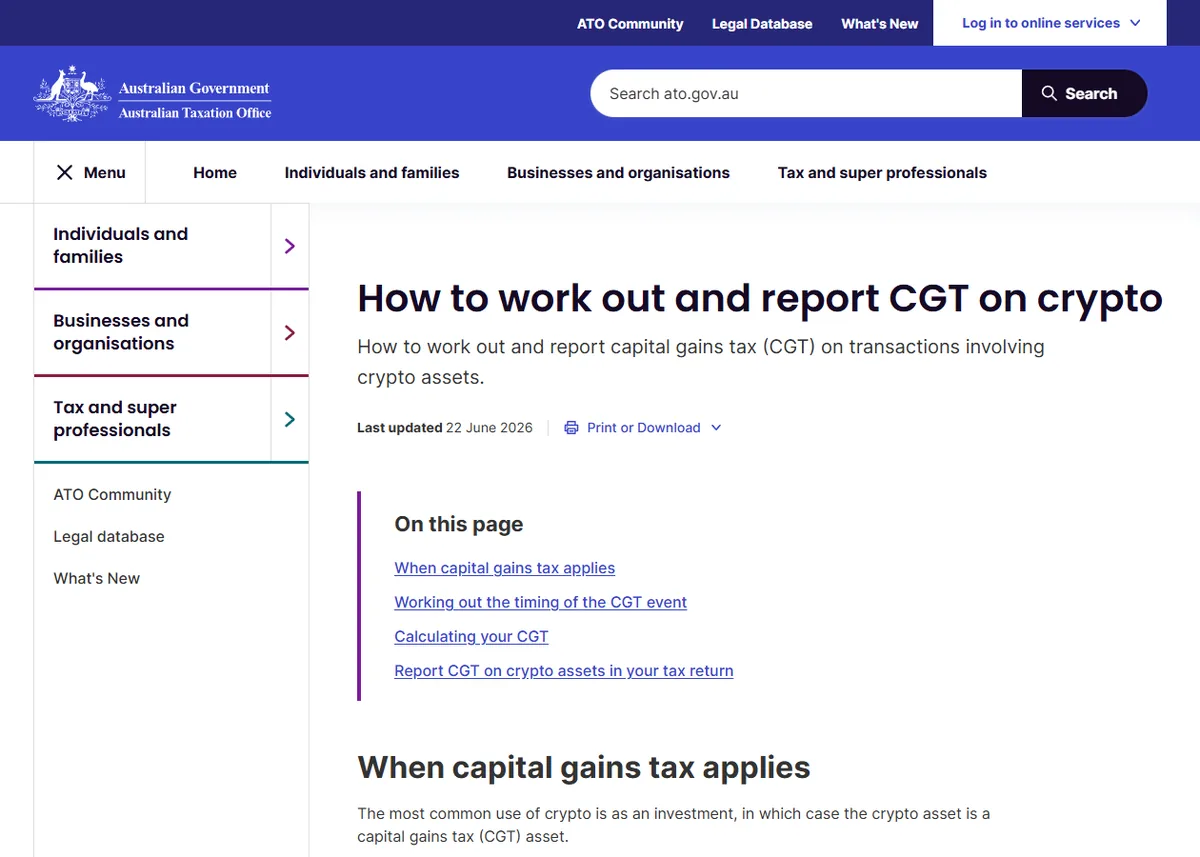
- ATO, How to work out and report CGT on crypto (22 June 2026)
- ATO, Crypto asset as a personal use asset (22 June 2026)
- ATO, Identifying shares or units sold
- ATO, Lodge your tax return online with myTax (22 September 2026)