India taxes every gain on crypto at a flat 30%, plus cess and any surcharge, whatever your income slab. The only thing you can deduct is what the coins cost you. A loss on one coin can't reduce the gain on another and can't be carried forward. On top of that, 1% TDS is deducted on most transfers; it's an advance payment you claim back against your tax, not an extra tax.
The rules at a glance
| Rate | 30% on the gain, plus 4% health and education cess and any surcharge |
| Deductions | Cost of acquisition only; no fees, no other expenses |
| Losses | Can't be set off against any income, including other crypto gains; can't be carried forward |
| TDS | 1% of the sale value on transfers above the threshold |
| Swaps | A swap is a transfer of both coins; TDS can apply on both sides |
| Where it goes on the return | Schedule VDA in ITR-2 or ITR-3 |
| Law | Section 115BBH and 194S of the 1961 Act; sections 194 and 393 of the Income-tax Act 2025 from tax year 2026-27 |
Why crypto losses can't be set off in India
Most countries let you add up gains and losses and pay tax on the net. India doesn't. Suppose you made ₹60,000 on bitcoin and lost ₹40,000 on another coin in the same year. Your net result is ₹20,000, but the taxable figure is ₹60,000, and at 30% that's ₹18,000 before cess. The loss is reported in Schedule VDA as nil.
This is why the calculator on this page shows two numbers for India: the usual net gain, and the total of your gains with losses left out. The second one is what the 30% applies to.
1% TDS: what it is and when it applies
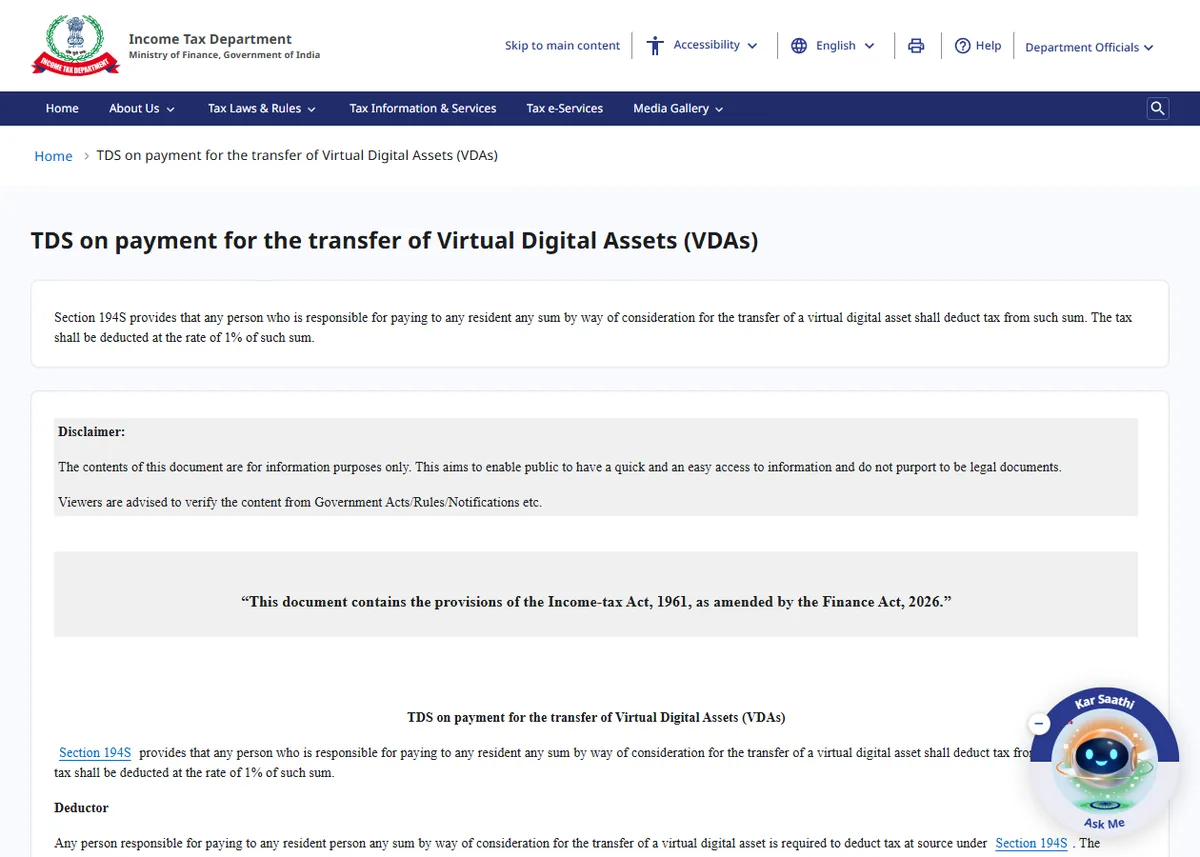
When crypto is transferred for consideration, the buyer (or the exchange, for trades on Indian platforms) deducts 1% of the consideration and deposits it with the government. It shows up in your Form 26AS and you claim it against your final tax.
No TDS is needed if the payer is a "specified person" (broadly an individual or HUF with no business income, or business turnover up to ₹1 crore or professional receipts up to ₹50 lakh) and the payments in the year don't exceed ₹50,000. For other payers the limit is ₹10,000. The Income Tax Department notes that when two coins are exchanged, both sides may have to deduct.
Which coins did you sell?
Indian law doesn't set a matching method for crypto. First-in, first-out is the approach most people and software use, and it's what the calculator applies. Whatever you choose, keep the records that show how you worked out the cost of each sale.
The new Income-tax Act
From 1 April 2026 the Income-tax Act 2025 replaces the 1961 Act. The crypto rules carry over unchanged in substance: the 30% rate and the no-deduction, no-set-off rules are in section 194, and TDS is in section 393. Returns for assessment year 2026-27 (the year ending 31 March 2026) are still filed under the old Act; the new sections apply from tax year 2026-27.
For assessment year 2026-27, the due date for individuals whose accounts aren't audited was 31 July 2026 for ITR-2. If you missed it, a belated return is still possible within the time limits, with a late fee.
Converting USDT trades to rupees
Most crypto trading happens against USDT, so exchange files often don't show a rupee value. The calculator values a trade against a dollar stablecoin at 1 USD and converts it at the ECB reference rate for that day. That's a reasonable estimate for checking your numbers, but for filing use the rupee value your exchange or records show.
Is Binance registered in India?
Binance serves Indian residents and has been registered with the Financial Intelligence Unit (FIU-IND) since 2024. If you're setting one up, our Binance sign-up guide covers the verification step and a few habits that make Schedule VDA easier to fill in each year.
Sources
- Income Tax Department, Section 115BBH (reviewed 22 September 2026)
- Income Tax Department, Section 194S and TDS on transfer of VDAs
- Income Tax Department, Income-tax Act 2025 section 194 and section 393
- Income Tax Department, Schedule VDA (updated 18 May 2026)
- e-Filing portal, ITR-2 FAQ