The first question in South Africa isn't the rate, it's whether your crypto is held on capital account or as trading stock. Hold it as an investment and a gain is a capital gain: 40% of your net gain for the year, after the annual exclusion, is added to your taxable income. Trade it and the profit is ordinary income taxed in full. Either way, SARS only accepts specific identification or first-in, first-out for working out what the coins cost.
Capital or revenue?
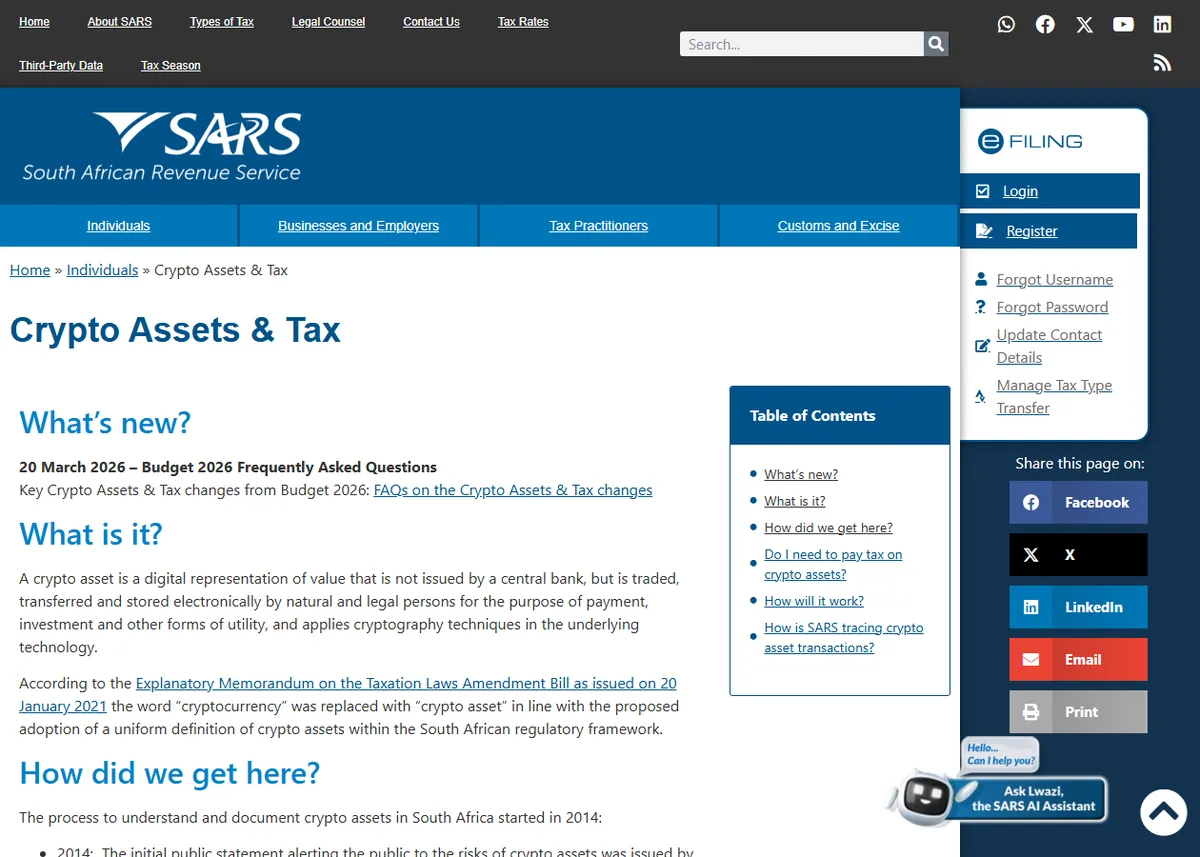
SARS applies ordinary case law rather than a crypto-specific rule. Its draft guide on crypto assets lists the factors it looks at:
- what you intended when you bought
- how you actually behave: how often you trade, how long you hold
- the nature of any business you run
- whether the holding earns anything or is just waiting for a price rise
The three-year rule that treats listed shares as capital after three years doesn't apply to crypto. Someone who buys a few coins and holds them for years is usually on capital account. Someone making dozens of trades a month to profit from price moves is likely on revenue account, even if it's a side activity.
If it's capital
| Inclusion rate | 40% of your net capital gain goes into taxable income |
| Annual exclusion | R40,000 up to the 2026 year of assessment; R50,000 from 2027 (years starting 1 March 2026) |
| Maximum effective rate | 18% (40% of the top 45% marginal rate) |
| Swaps | A crypto-to-crypto swap is a disposal, treated like barter |
The annual exclusion covers all your capital gains and losses for the year, not only crypto, so add everything up first.
Base cost: FIFO or specific identification only
In its clarification for exchanges reporting base cost, SARS says base cost must be worked out using either specific identification or first-in, first-out, and that the weighted average method isn't available because crypto exchanges aren't "recognised exchanges". The calculator on this page therefore uses FIFO for South Africa.
Exchanges are now reporting base cost information to SARS on the IT3(c), so the figures in your return should reconcile with what the exchange sends. That makes clean records from the start worth a lot.
When to file
The 2026 tax year ran from 1 March 2025 to 28 February 2026. For filing season 2026:
- auto-assessments: 1 to 12 July 2026
- non-provisional taxpayers: 13 July to 23 October 2026
- provisional taxpayers: 13 July 2026 to 22 January 2027
If you have crypto gains that aren't taxed through PAYE, check whether you should be registered as a provisional taxpayer.
Rand values for USDT trades
Most exchange files show trades against USDT rather than rands. The calculator values those at 1 USD and converts with the ECB reference rate for the day, which is a good first estimate. For your return, use the rand values your records support.
South African residents can use Binance's global platform; our Binance sign-up guide walks through verification and the export you'll need at filing time.
Sources
- SARS, Crypto assets and tax (20 March 2026)
- SARS, Draft guide to the taxation of crypto assets (draft for comment, July 2026)
- SARS, IT3(c) clarification on base cost for crypto assets (2 June 2026)
- SARS, Inclusion rate and Annual exclusion
- SARS, CGT rates (26 February 2026)
- SARS, Filing season (21 September 2026)
If you're unsure whether your crypto counts as capital or as trading stock, a registered tax practitioner can tell you.